
Small-scale multi-unit housing
Small-Scale Multi-Unit Housing in Esquimalt — what’s happening and why your voice matters
Esquimalt is a community that people want to live in, and want to stay in. It’s a place where people walk to the waterfront, know their neighbours, support local businesses, and put down roots. People from all walks of life call Esquimalt home, and that diversity, the mix of people, backgrounds, and stories that share these streets, is what makes this community what it is. It’s also a community going through change, and the Township wants to make sure that change happens in a way that reflects who we are and preserves what we value.
How we got here
In 2023, the BC government responded to immediate and growing future concerns about housing supply across the province. As such, they implemented blanket legislation that required every municipality in BC with a population over 5,000 to allow Small-Scale Multi-Unit Housing (SSMUH) through Bill 44 The legislation prohibited the Township from having a public hearing associated with the Zoning Bylaw amendments that implemented the SSMUH zoning. Every qualifying municipality in BC was required to comply by June 30, 2024.
In response, the Township of Esquimalt passed Bylaw 3142 in June 2024, creating two new residential zones — RSM-1 and RSM-2— that allow up to three or four dwelling units on most residential lots. Properties in tsunami hazard areas are exempt. In addition, Esquimalt had no provincially recognized Transit Oriented Areas (TOA's). Zoning bylaw amendments to recognize that routes 14 and 15 have recently become frequent transit routes.
What the Township can and cannot change
While the province decides how many dwelling units are allowed on a lot — that number is fixed by provincial law and cannot be reduced locally. What the Township does have meaningful control over is how those dwelling units are built and fit within our neighbourhoods. The rules are already in place, and now we’re asking the community what’s working, what isn’t, and what we’d like to see improved. Areas open for community input include:
- Building height — how tall a new building can be
- Setbacks — how far a building must sit from property lines
- Lot coverage — the proportion of a lot that can be built on
- Parking — the number of onsite spaces required per living space
- Landscaping and green space — requirements for planting, permeable surface, and outdoor amenity
- Tree retention — what happens to existing trees when a property is redeveloped, when can they stay and when can they be removed
- Privacy and overlook — measures to protect neighbouring properties from upper floors
- Building form and character — how buildings look and relate to the street and surrounding homes
These are the provisions that shape what you see and experience in your neighbourhood. Any proposed changes must still allow development to occur in a financially feasible manner.
What Bill 44 allows
The number of living spaces permitted on a residential lot depends on lot size and location as outlined in:
- Up to 3 dwelling units on lots under 280 square metres
- Up to 4 dwelling units on lots 280 square metres or larger
- Up to 6 dwelling units on lots over 280 square metres that are within 400 metres of a bus stop on a frequent transit route.
What we’ve heard
Since the bylaw came into effect, residents and Council have heard a range of perspectives — concerns about building height and massing, green space and tree loss, privacy and parking, and how new development fits the character of established neighbourhoods. There have also been voices welcoming the opportunity for more housing options in a community people want to be part of. Council has listened to all of it, and in April 2026 directed staff to take a closer look and hear from the community before any changes are made.
We’ve had a look around
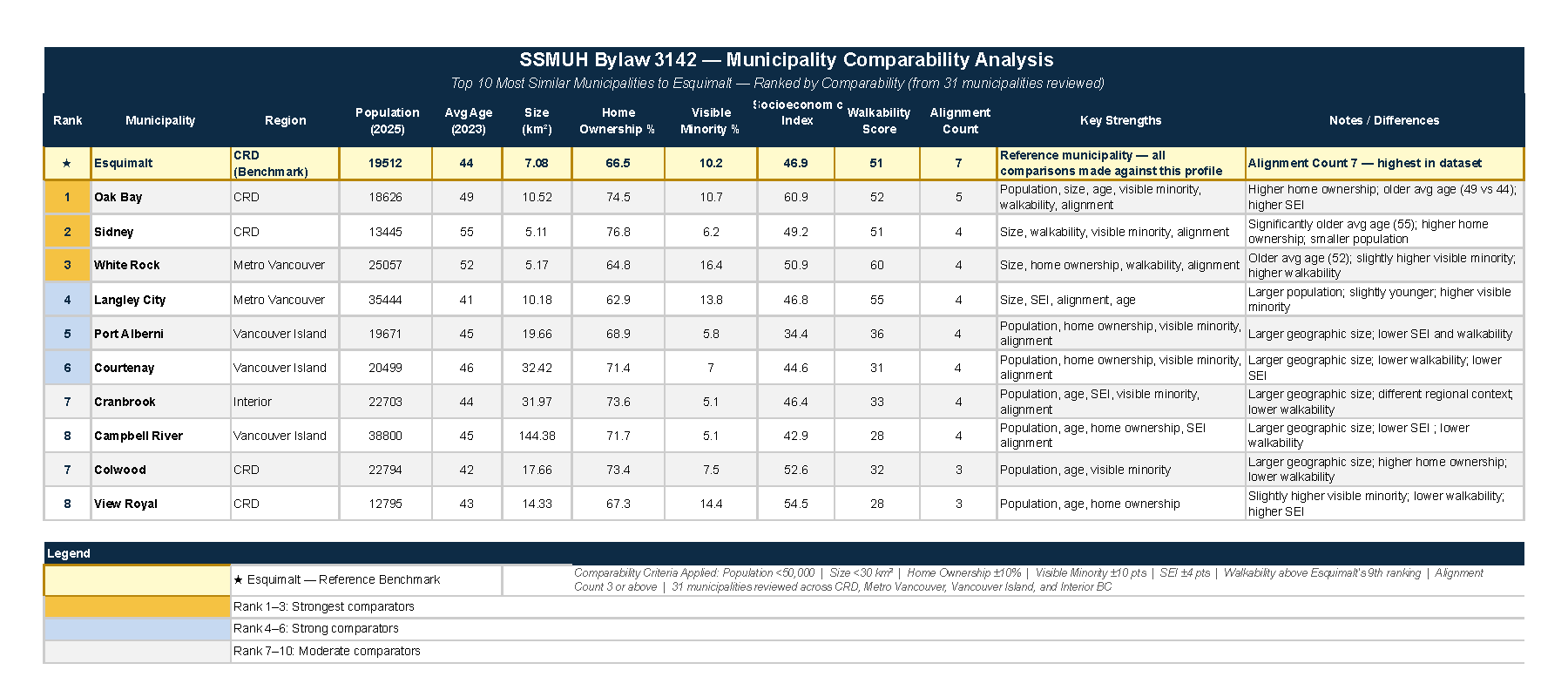
We looked at what other municipalities across BC have done and found that the areas listed above are exactly where communities have tailored their bylaws to reflect what matters most in their own neighbourhoods. The table below shows where Esquimalt's current bylaw sits, what the province requires as a minimum, and the range of approaches taken by other B.C. communities.
What we’re asking you
The Township is inviting you to share your perspectives. Whether you live, work or play in Esquimalt, your experience of this community matters.
You can participate by completing the online survey that is open until July 4, 2026, or by attending the all-day community workshop on June 29, 2026.
The workshop has limited seats and registration is required — register here.
If the workshop reaches capacity, you can add your name to the waitlist in the event a space opens up. The survey and the workshop are both contributing to a report to council to ensure residents keen to share their thoughts have the opportunity to do so.
We know June 29th falls at a busy time — the end of the school year, with summer just around the corner — and we appreciate that life doesn’t slow down for planning processes. That’s exactly why we’re also making it possible to participate online, so that no matter what your schedule looks like, you can still have your say.
